Verifiedon 2026.7.1-2
View this course’s maintenance history
Practical outcome
What this gives you
- Identify agents, Gateway, models, channels, tools, and state in a deployment map
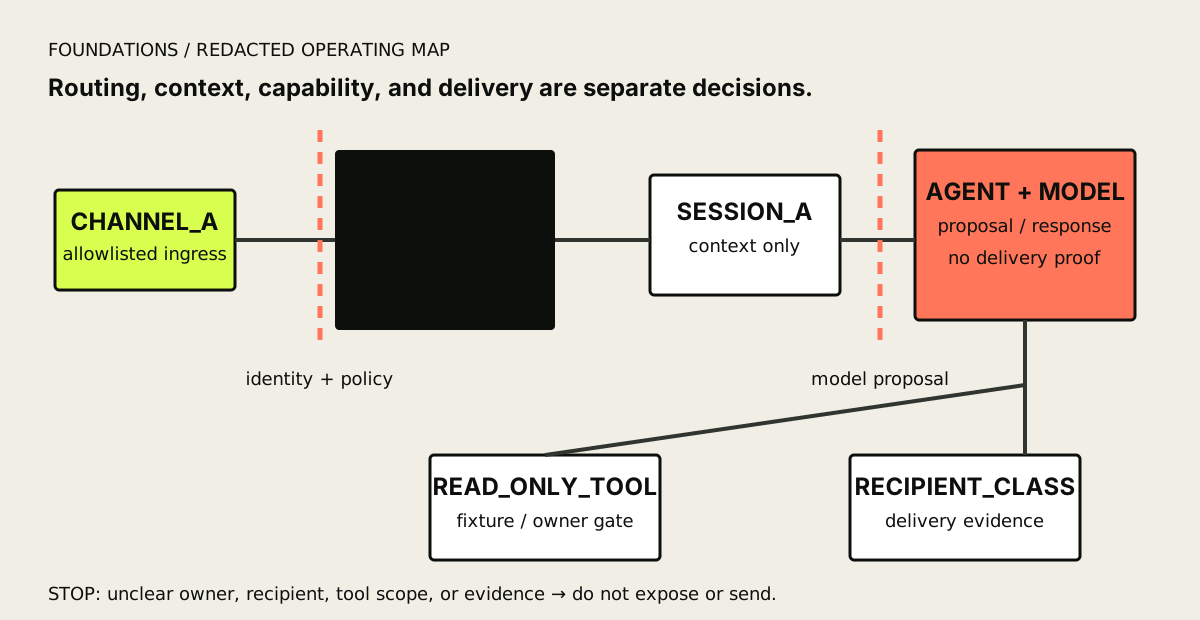
- Trace a request from inbound message through a tool boundary to an outbound response record
- Mark identity, data, and tool trust boundaries without treating a session as authorization
- Assign an owner and stop or escalation rule to every external action
Preflight
Before you start
No prior course required.
Syllabus
Work through the map
- Map the Gateway and its operating surfaces20 min
- Trace one request through the agent loop20 min
- Separate sessions, transcripts, and durable memory20 min
- Distinguish tools, skills, plugins, and authority20 min
- Set channel and trust boundaries before exposure20 min
- Capstone: publish an operating map, not a deployment20 min
- Final assessmentAfter coursework
Course details and supporting evidence
What you will build
Before you install, expose, or automate anything, you will build an operating map that another operator can review. It makes the request path, state, external capabilities, ownership, and stop rules visible. This is a course about understanding a system before operating it—not an installation guide and not a substitute for the Security course’s control implementation.
Course map
- Operator mental model — map the Gateway, clients, nodes, channels, models, tools, and state.
- One request in motion — distinguish a model proposal from a confirmed tool or outbound action.
- Sessions and memory — choose isolation and retention deliberately.
- Capabilities — separate tools, skills, plugins, and enforcement boundaries.
- Channels and trust — reason about ingress, recipients, prompt context, and when one Gateway is not enough.
- Operating-map capstone — publish a redacted review artifact with source receipts and escalation rules.
Learning assets
The lessons use text diagrams, decision tables, and redacted evidence templates that remain readable without images or JavaScript. The capstone requires a system/data-flow map, three explicit boundaries, named owners, and stop/escalation rules. Do not insert secrets, private transcripts, recipient identities, QR codes, or copied third-party course material into your work.
Checkpoints
- Which component owns routing and sessions? The Gateway, not an individual channel or browser client.
- Does a session key authenticate a sender? No; it selects routing/context.
- Does a skill enforce a safety policy? No; skills are instructions. Tool policy, sandboxing, approvals, and external permissions constrain authority.
- What is the correct response to mutually untrusted users sharing a tool-enabled agent? Separate Gateway trust boundaries, ideally including separate credentials and hosts or OS users.
Video curation note
No video is embedded in this course. The lessons and assessments are complete without third-party media; immutable primary-source receipts remain the technical authority.
Freshness and changelog
Owner: academy-editorial. This course has a 60-day source-review SLA. The source receipts below record the exact OpenClaw stable revision reviewed on 2026-07-30; re-review when those dependencies change or by the stated due date, whichever comes first.
Primary source receipts
The six lessons are grounded in direct OpenClaw documentation at revision 2e26244cec32e61f6117740d3ea273b1ecb54efc (stable 2026.7.1-2): architecture, agent loop, sessions, memory, tools, skills, channels, and Gateway security. These are receipts for documented behaviour, not deployment approval.
The course visual asset system boundaries SVG is original Academy artwork, contains no third-party screenshot or personal data, and is used as a labelled review aid in the capstone.